Happy 10th Birthday, Londinium!

Saturday, December 13, 2014


This happened ten years ago today. It's been an absolutely delightful ride, and I can't wait to see what the next ten years have in store! (Publication, perhaps?)

Victorian Sexuality Linkdump the Nth

Thursday, November 6, 2014

I do a lot of digging around on this just because I find it so interesting that a society that is just as sexually diverse as our own is labeled 'prude' because of its social debates on sexuality.

To be fair, I live in 21st century America, which actually is prude compared to a lot of other cultures, namely because we're having a lot of the same debates that the Victorians were having. Still. In 2014. I don't know, either. It's ridiculous.

Anyhow, here are some more resources on Victorian sexuality, one of my favorite things to read about:

The Londinium Cast Joins Tumblr

Wednesday, November 5, 2014

This actually happened months ago, but I forgot to post about it here, so here we go now.


You can bother the cast of the stupid book over at Ask Londinium with all things Victorian.

...also, feel free to ask Will about porn. He really wants to talk about porn.

Actionable Offenses: The Victorian Derek and Clive Album

Tuesday, January 21, 2014

If anyone ever tries to tell you the Victorians were prudes, you can now whip out audio proof to show them otherwise.

Somehow, I missed the release of Actionable Offenses back in 2007, probably because I was focused on the time on graduating high school and beginning my undergraduate career. Interestingly, at the time it was released to the public, I was spending a lot of my time listening to its modern equivalent, Peter Cook and Dudley Moore's Derek and Clive albums, which I never imagined myself describing as a spiritual successor to anything. (As someone who considers herself a comedy historian, that really does feel weird to type.)

Anyhow, before Comstock managed to enact his obscenity laws, in the 1890s more than a few comedians and some amateurs took pleasure in recording inappropriate sketches and stories on wax cylinders. These would be listened to on phonographs, and most of these recordings were destroyed when Comstock's reign of terror began. Fortunately, a few managed to survive in various archival institutions and were preserved well enough to be combined into this CD, which can be purchased from Archeophone Records, a favorite of archivists and historians.

I've written a bit about Victorian sexuality here before, as it's one of those research areas I'm fascinated by (namely because most people don't know that the Victorians were as lurid as we are now), but this is a really great example of the Victorians doing something we all do now - speaking into a recording device and saying naughty words. We all did it when we were 13, after all. There are trends we historians notice that don't actually change much from generation to generation, and the discovery of swear words and sex is one of them, especially when it comes to somehow recording it (whether it's written, drawn, or recorded). For some prime examples of Victorian written pornography, I can direct you both to The Pearl, a magazine published between 1879-1881 before being shut down for obscenity, and author Robin Wolfe's hilarious and delightful finds on her blog tagged with 'Victorian Porn Fridays.'

To close, I'd like to go back to Derek and Clive. For the unacquainted, what happened was simple: Peter and Dudley rented a studio, got drunk, and said really stupid and explicit things into an audio recorder. Once sobered up, Peter started sharing the tapes with friends, which made Dudley really uncomfortable until he realized it was extremely popular. The two ended up doing a couple more albums as Derek and Clive, but the break-up of their double act (which always makes me cry like a baby) prevented any more from happening.

The amazing thing, though, is that the boys were not the first to make money off of obscene recordings, and they certainly won't be the last. Actionable Offenses does historians a great service by putting the 1890s Derek and Clive-esque recordings together and making them accessible to researchers (and purveyors of smut, of course), but the amazing thing is that the recordings actually stand the test of time. They're still funny today in the way I imagine Derek and Clive will still be funny to 13-year-olds everywhere in 100 years. Dirty words just never get old.

Short Story: I'm (Not) Gonna Write You A Love Song

Sunday, October 13, 2013

No spoilers in here, so I can post this for you all to enjoy! Basil's fallen in love for the first time since the death of his fiancee (via illness), but he doesn't know how to let Miss Annabell Simmons know he's interested in marrying her. Dustin tries to help out in the only way he knows how.

----

“This is going to sound stupid.”

“Stupid? Naw.” Dustin closed the keyboard and leaned on his piano. “There’s no such fing as a stupid question.”

Basil sighed. “How do I propose to a woman that I think I love but who I…I don’t know. She’s not Emily, and that’s been making this difficult.” He wrung his hands nervously. “See? Stupid question.”

“You wanna propose?” Dustin grinned. “That’s not stupid!”

“No, but I’ve proposed before – to Emily – so I shouldn’t have to ask.”

Dustin shrugged. “Miss Simmons ain’t Emily, though, so it’s owlroit.” He rolled his gaze to the ceiling. “Hmmm.”

“Ms. Simmons enjoys going to the theatre, balls, music – ”

“That’s it!” Dustin snapped his fingers.

Basil blinked. “What’s it?”

“Music! Wroit ‘er a love song, Mister Remington!”

Basil blinked again, stunned. “What?”

Dustin raised an eyebrow in mock confusion. “Don’t tell me you don’t know wot a love song is.”

“Of course I do! I just can’t write one!” Basil felt the blood rushing to his cheeks, but resisted the temptation to raise a hand to check the temperature of his face.

“But yer such a good wroiter…” Dustin frowned, but only briefly. “I know! You wroit the words an’ I’ll set it to music fer you!” he added, his characteristic smile returning almost immediately.

“But…I’ve never written anything like that before.” Basil fidgeted.

“‘Ere, I’ll show you.” Dustin patted the piano bench and slid over, and Basil sat beside him. He opened the keyboard again and cracked his knuckles. “Let’s assume that I’m a pretty lady and I’m in love wif you.”

Basil glared at him.

“Y’know,” Dustin went on, “I’d just ‘ave longer ‘air an’ be better endowed ‘ere.” He waved a hand in front of his chest, and he noticed Basil’s glare visibly soften out of amusement. Oh, you fout that were funny.

Basil exhaled. “Right. So supposing you were a lady in love with me – what is this even supposed to do?”

“Get you in the roit mood er wroit, Mister Remington. ‘S called ‘acting.’” Dustin’s innocent face gave absolutely no indication of the words he was about to sing.

“We’re turning this into theatre now?” Basil rolled his eyes. “Come on, Thatcher, be serious!”

Instead of being serious, Dustin began to play the piano, quickly feeling out the opening bars of the introduction. Before Basil could lodge a protest, he began to sing.

“There is a man, an ‘andsome man, wif eyes as blue as the sea…That ‘andsome man, that very man, belongs at last to meeee…” Here the tempo picked up, becoming jaunty. “Marry me, woncha just marry me, woncha just please, oh, please just propose to me, I would ‘appily, say yes if yer askin’ me, so woncha just please, oh, please just take a knee?”

Basil’s jaw dropped.

“I love youuu Mister Remingdon – da da, da da – I love you wif all of my ‘eart, won’t you please say you’ll marry me so we can get a ‘ole new staaaart!” Dustin finally stopped as he choked up with laughter. “See ‘ow easy that were?”

Basil said nothing. He continued to stare, his mouth agape and his cheeks flushed. Dustin turned to face him and the sight of Basil’s face made him laugh even harder.

“Thatcher!” Basil snapped, then caught himself before saying anything more. He thought for a moment, and without realizing it he smiled. For that one moment in time, he was relaxed. It hit him then that he’d lost touch with a huge part of himself – that tie he’d had with Emily was based on their shared senses of humor. And when he really thought about it, he bantered back and forth with Dustin far more than he did with Annabell. She always seemed like she was keeping her distance, come to think of it.

Dustin smiled genuinely at him in return, and in that moment he was definitely sure that something was up because Annabell never smiled at him like that. She was guarded somehow.

“Thatcher,” Basil said again.

Dustin cocked his head to the right. “Mmm?”

Basil stuck out his hand. “Thank you.”

Even more confused now, Dustin nevertheless shook Basil’s hand. “Yer welcome?”

Basil stood up. “I’ll explain later. I have business to attend to now – as soon as I return, I’ll explain.”

Dustin nodded at him. “Owlroit.” He grinned. “Good luck, Mister Remington. You shook me ‘and, so you’ll be foine.”

Basil smiled earnestly back. “I’ll need it,” he replied, then walked off through the main hall of the bank, one hand raised in a ‘see you later’ wave.

He still wasn’t quite sure what he made Basil realize, but Dustin felt immensely satisfied.

How Basil and Dustin Became a Double Act

Wednesday, April 24, 2013

I hadn't drawn them in a while and felt like I was missing out. Then I got to thinking about them and realized I never wrote a post about this.

I think Basil's hair has undergone about ten changes over the past year. I should chronicle this at some point.

Basil and Dustin didn't start out as a double act. They weren't meant to even know each other that well at all originally. Notes I have dating back to 12/13/04, the date the project officially began, state that "the point of the story is to get across how important it is to simply enjoy life and have fun, something Basil learns throughout the course of the tale from various people, including Dustin." They quickly started to get along as my notes expanded, and within a day or two of the story's genesis it was clear that the two were going to go on adventures together with little Charlie Jenkins in tow.

A brief timeline of what happened, complete with mentally scarring links to my old deviantART account:

  • 12/10/04: I did two doodles (one | two) of Charlie in anthropology class. He got colored images on a horrible character sheet later.
  • 12/12/04: Horrible character sheets for Dustin and Basil appeared.
  • 12/13/04: I decided that I was onto something and started to take notes on 'the Christmastime Victorian London Story,' which eventually got the much better title of 'Londinium.' 
In those early notes, Dustin and Charlie tend to stick together and pop in to help main character Basil out when needed. However, Dustin and Basil turned out to have on-page chemistry early on and so I juxtaposed them a lot. They got along, but were often at odds, with Dustin generally teaching the somewhat boring and naive Basil about life. This was a very boring story.

To make it less boring, villains were introduced and proper adventures began to emerge as the characters showed themselves more to me, and Basil revealed to me that he actually wasn't boring and naive at all and just had an insanely good deadpan. I sifted through a ton of bad ideas because when you're in high school you often think you're being clever and meaningful when you're really just being stupid, but there was something missing still.

I found it in January of 2007. It was only a few days after the new year had started, and I somehow made my way on Wikipedia to the 'double acts' page. At this point, Basil and Dustin were starting to act a lot more like one, but I can't actually remember how I ended up on the page. What I do know, however, is that it was fate.

It was fate because I discovered Peter Cook and Dudley Moore, who reminded me so much of Basil and Dustin that  it actually freaked me out a bit at first. They had way too many things in common, including the height disparity, Basil and Peter both being former prefects, Dustin and Dudley both being piano players, and a ton of other weird things. But the bit that really caught my eye was the whole corpsing thing. Basil and Dustin were developing their friendly 'let's make each other laugh at bad times' rivalry at this time, and the fact that it happened between two real-life people who were eerily similar to my own characters was striking. So I threw it in and let their stupid game blossom because it was entertaining me.

Basil and Dustin ran away with it and ended up revealing to me that both had once had comedic aspirations as younger men. I told them that they should keep going and I would write about it. They agreed to become a double act and Londinium finally started going in a proper direction.

The double act itself has its origins in the 19th century in music hall and vaudeville - a straight man would stand up with a comedian and repeat the comic's lines so that the audience would know a joke was coming up, i.e.:

First Performer: So I went to the races last week, and...
Second Performer: Oh, you went to the races last week?
Audience: (shuts up)
First Performer: (tells joke)
Audience: (laughs)
And so forth.

By the end of the 19th century, though, double acts evolved into what we know them as today, and whilst I'm not going to do a giant lecture on them here (that would be a post better suited for one of my other blogs) it's important to note here that Basil and Dustin don't actually perform as a double act because that would be anachronistic in the 1860s. They do, however, write as one. In the Londinium universe, they simply consider each other a comedy writing team who occasionally do sight gags that require them to hold poses for about three minutes whenever they're photographed. Outside of the universe, they'd probably be labeled as a double act pretty much instantly due to the way they banter well and cross-talk all the time.

So in summary, whilst Basil and Dustin don't have an adorable leg of lamb story, the fact that they managed to come this far despite the fact that my initial characterizations of them were awful is somewhat heartwarming in a 'Steph's writing used to suck and now it sucks less' sort of way.

Just To Remind You Your Art Always Gets Better...

Thursday, March 14, 2013

Two drawings I've done of Dustin. The one on the left dates to 12/30/2004; the one on the right dates to 2/22/2013.


When Satire Fails

Sunday, February 24, 2013

This was back in 2007, but it still ought to be shared.


I get that they're making fun of conservative political cartoons here, but did they have to do it at librarians' expense? I happen to enjoy reading satire (and occasionally trying to write it), and the fact that they propagated one myth to shatter another makes me really sad. I normally love the Onion, too.

Now, I'm sharing this here because I'm currently in grad school to become an archivist and because quite a few of my characters in Londinium work as satirists. I have to point out why this doesn't quite work satirically. When you write or draw satire, you're trying to show things how they really are by making fun of them using exaggeration. In this case, they're trying to make fun of conservative political cartoons. Unfortunately, they've done this by representing another group of people incorrectly - librarians. 

Satire doesn't work so well when you show one myth to be false whilst simultaneously continuing to convince the public that another myth is real.

What the hell is a 'comic pianist?'

Wednesday, February 20, 2013

John Orlando Parry.
I figured that this would be a good post to write because...well, it's not really a thing people know much about besides the fact that Victor Borge existed and was an extraordinarily funny, talented man. Of course, there's a precedent for what he did, and it can be found in music hall.

The person Dustin looks up to in this field - besides his hero Franz Liszt - is a man by the name of John Orlando Parry. Amongst other things, the man was a songwriter, composer, cartoonist, painter, piano and harp virtuoso, singer and actor. But it's that piano bit that we want to focus on here, because as his career advanced as a performer, he began doing something of particular interest to our young Mr. Thatcher, as well as other performers like George Grossmith.

In 1860, the following happened:
On 4 June 1860, he joined Thomas German Reed and his wife at the Gallery of Illustration, Regent Street, London. Here he performed for nearly nine years, presenting a series of droll impersonations and musical monologues that inspired other comedians, including George Grossmith. He built comic sketches with musical illustrations around his own comic songs. He wrote these entertainments, composed his own music, and played his own accompaniments.
Naturally, we can see where this is going with regards to Dustin. Dustin keeps his ear to the ground when it comes to music, so at age 21 we can imagine he was fully aware that Parry was doing this. It would combine his theatre background and genuine love of the piano, so he'd probably be inspired to give it a try himself. The hard part, of course, is finding an audience for this sort of thing when you're working class and not everyone around you gets your composer parodies. But that's where Basil comes in.

Therefore, what we can conclude here is that during the 19th century the term 'comic pianist' was defined by music hall performers whose primary instrument for comedy was the piano. They'd do silly sketches and play funny songs, as well as impersonate composers and crack bad jokes as the night went on. Dustin, along with colleague Thorvald Abramssen, more or less work in a similar fashion. In the 20th century, the tradition continued most famously with Victor Borge:


Thorvald is of Danish heritage in tribute to Mr. Borge, but the comedian that most inspired how I write Dustin was also a piano virtuoso in his own right and did the most devastatingly perfect parody of Beethoven I've ever heard.


So there you are. That's basically what Dustin says he wants to do when he tells people he's going into the field of 'comic pianism.' Not that it's a field or anything, but now you have a better understanding of what it's all about.

To see a bit of John Orlando Parry's combination of cartooning and music, check out his 'Manual of Musical Terms' here.

Today is Ada Lovelace's birthday!

Monday, December 10, 2012


And she got a Google Doodle in honor of it! I couldn't be happier - this woman is one of the reasons I'm able to type this blog and post this image in the first place. Thanks, Ada!

If you're unfamiliar with Ada, read up on her right now!

The Londinium-Writing Playlist

Sunday, December 2, 2012

I'd make Dustin write this post, but there's some modern music on here, so I'll take care of it so he doesn't have to.

Anyhow, when you're writing a certain story, sometimes it helps to have a playlist of songs that make you think about the project. Londinium has a playlist of its own, of course:


Some of the songs are a bit surprising on there - the Spice Girls and Morning Musume songs are more jokes from my senior year of high school than anything, but that was when I passionately threw myself back into this project for the first time. Sometimes it's the place in your life that you think of when you hear a song that calls forth memories of what you were working on at the time. We writers are strange people sometimes. 

Also, any Mozart or Liszt on this playlist that you see (including Liszt's famed Hungarian Rhapsody No. 2) are songs that Dustin enjoys playing. Just ask him and he'll feel free to tell you all about why.

Letters From An Old Etonian: Letter 3

Monday, November 26, 2012

I have to admit that I was rather reluctant to post these here at first, as my instructor Herman Bagstock could have probably sued me for libel if he found these. However, he's very fortunately dead, so this can go on the internet and I don't have to worry about a thing.

This is the third of a series of stories I wrote when I was a schoolboy at Eton. They've been dubbed 'the Dirty Schoolboy Papers' because they're extremely inappropriate because when you're around that age you think that sort of thing is hilarious.

All names, including the surnames of my friends, have been changed because when I wrote this I didn't want to get in trouble.


Letters From An Old Etonian: Letter Two

Sunday, November 25, 2012

I have to admit that I was rather reluctant to post these here at first, as my instructor Herman Bagstock could have probably sued me for libel if he found these. However, he's very fortunately dead, so this can go on the internet and I don't have to worry about a thing.

This is the second of a series of stories I wrote when I was a schoolboy at Eton. They've been dubbed 'the Dirty Schoolboy Papers' because they're extremely inappropriate because when you're around that age you think that sort of thing is hilarious.

All names, including the surnames of my friends, have been changed because when I wrote this I didn't want to get in trouble.


Letters From An Old Etonian: Letter One

Saturday, November 24, 2012

I have to admit that I was rather reluctant to post these here at first, as my instructor Herman Bagstock could have probably sued me for libel if he found these. However, he's very fortunately dead, so this can go on the internet and I don't have to worry about a thing.

This is the first of a series of stories I wrote when I was a schoolboy at Eton. They've been dubbed 'the Dirty Schoolboy Papers' because they're extremely inappropriate because when you're around that age you think that sort of thing is hilarious.

All names, including the surnames of my friends, have been changed because when I wrote this I didn't want to get in trouble.


Christmas is coming...are you ready?

Friday, November 23, 2012

As the holidays kick into gear, I kick into gear too. There's Victorian imagery everywhere around Christmas - the Victorians loved Christmas as much as modern-day Christians do, and they helped transform it into what it is today. This, naturally, makes me write like a crazed person.

I also tend to draw the cast more, which is nice because drawing them makes me write about them, too. Here's an updated Huddleston Players image because I can.


I'll write an inevitable Victorian Christmas post down the road - sometime this month, for sure - but for now, let's remember that the Victorians at least understood the holidays were about spending time with friends and family and not rushing out at midnight to buy things and trample people as soon as Thanksgiving's over.

(Besides, you all should've been watching Punkin Chunkin instead.)

I've been bitten by the Downton Abbey bug...

Sunday, September 30, 2012

So I'm finally getting around to watching all of Downton Abbey, and my parents have joined in with me on this venture. We finished Series 1 today and are planning on starting Series 2 as soon as Dad returns from a business trip. It's quite a good show, actually, and what I'm most fond of is that it's historically accurate. It's always nice to find a series that actually gets things right for a change - I'm not sitting around complaining the entire time.

I also may or may not have a bit of a crush on Branson because I like people who drive things. Ignore me.

Can you blame me, though? No, you can't, you silly person.

Anyhow, this whole thing got me thinking about costume dramas/historical TV shows, and I'm wondering why Downton is succeeding in the United States where other series have failed. Almost everybody watches Downton Abbey here. I'm not sure what's working for it that other series don't have, but the plot is extremely gripping and the characters are so lovable. I have this sinking feeling that the belief that history is boring had a lot to do with the lack of historical dramas in the United States in the past, although I'm starting to notice that they're picking up here (Boardwalk Empire, the three-part Hatfields and McCoys TV film series, etc.). It's really quite refreshing to see something I care about so much becoming something other people enjoy, as well.

Also, a special thank you to Downton Abbey for reminding the world that World War I did happen. People tend to forget about it because it was overshadowed by World War II. I enjoy reading about WWI, especially since an ancestor of mine fought in it, so having an entire series of the show focused on WWI ROCKS. Thanks, Julian Fellowes!

I really should get back to writing Londinium now, but I just wanted to be excited for a moment over a show that both gets history right and draws in millions upon millions of people each week. The world is a better place for it.

So the Georgians had laughing gas parties...

Thursday, July 12, 2012

I watch game shows quite often, generally because the completely random things they ask the contestants from time to time give me ideas for things to look into. Today I happened to hear a question regarding the early use of nitrous oxide, so I looked into it...and found this.

Namely, in the 1790s, aristocrats started using nitrous oxide recreationally at parties. They referred to these as 'laughing gas parties' and basically all gathered in rooms and breathed in the gas until they reached a euphoric state. It sounds an awful lot like getting high with your friends, only with less harmful drugs and more gases that work as anesthetics. I can't speak from experience on either front since the only drugs I've ever taken at the dentist are modern anesthesia and Novocain and the only recreational drug I've ever used doesn't really count since it's the caffeine in my soda (although I am trying to curb my addiction, which is a story for another time), but I think it's a fitting analogy.

I did a little research on these 'laughing gas parties' because it sounded like something Nigel would stumble onto in his research and have to experiment with because he's Nigel, and here's what I found:

By the 1860s, nitrous oxide was being used as anesthesia for dentistry, but until then it was relatively uncommon and hard to come by, so these parties were generally reserved for the wealthier set. That being said, Nigel has access to both scientific research and money, so he'd be able to grab some for himself easily to see if it both kills pain and makes people euphoric and giddy. Which means he needs test subjects. Which means the domestic staff should run very, very far away because he tends to experiment on them.

And then there's his deadpanning big brother - Basil's involvement in this could be pretty darn interesting. I'll be filing this one away to see what I can do with it at a later time...

Using The Right Terms For Victorian Photography

Monday, April 23, 2012

This is easily the most random post I've ever written, but after messing around with the 'time machine' filters on Paint Shop Pro too much tonight I realized how much I hate when people just apply the terms 'daguerreotype' or 'tintype' to EVERY SINGLE PHOTO they see from the 19th century. There were a bunch of different photography techniques in use throughout the century, and many, if not most, of them overlapped. Let's talk about those now just so I can get this off my chest and fall asleep soundly.

To demonstrate the use of some of the more common ones, I took a drawing of Dustin, did some strange things with it in Paint Shop Pro, and then applied the time machine filters that were applicable to it.

Trashed Londinium Ideas: The Post

Monday, April 16, 2012

I don't quite know what inspired this post, but there have been quite a few trashed Londinium ideas over the years, and I can share them now since they won't appear in the books at all. I started this book as a sophomore in high school, when I was young and stupid. I'm older and slightly less stupid now, so my ideas are significantly better than they were seven years ago.

Seriously, Londinium is going to turn eight years old in December. That's kind of scary to think about.

Anyhow, I'm going to go through trashed ideas year by year, starting in December of 2004 when this project was first conceived. There are a lot of terrible ideas in my little green ledger. It's very pitiful.

2004

  • Charlie was raised in an orphanage/workhouse, not the brothel his mother worked at. This was deemed too similar to Oliver Twist and was therefore dropped.
  • Basil is originally listed in my notes as being the "intern to a banker." Yeah. About that...
  • Dustin only cleaned chimneys - no mention of his musical talents. He also often longingly looked at a rich "lady in the window," with whose world he was fascinated and knew he'd never reach.
  • Annabell Simmons and Basil originally stopped dating due to another man. This changed within one day.
  • 'Guvmate,' the one thing retained from the earlier notes, dates back to 12/15/04, but it's been rewritten what feels like upwards of ten times. 
  • Monty Houghton first appears in my notes on 12/20/04 as a much more violent, angry person than he is now.
  • Dustin's original height was 5'8". He's now 5'2".
  • Sullivan, the man Dustin was apprenticed to when he was learning how to clean chimneys, was a jerkface, for lack of a better word. The only surviving image of him that is even slightly presentable is from my old deviantART account:

2005
  • There are legitimate notes regarding something called "Londinium the Musical." There are even some song attempts in existence. I should probably light those on fire.
  • Robert Sheldon was actually diligent at work. Now he's a clock-watcher.
  • First mention of a poet on 1/10/05. Back then, the idea was supposed to be meaningful. This evolved into Kynaston Jordan, whose poetry was so bad that Basil and his friends used to do competitive readings of it at Eton. I like this better than the idea being meaningful.
  • Ironically, Sir Norwood Linsay and Gib Merton both appear in January 2005 and are essentially the same people, although their backstories are deeper now.
  • Monty was a sadist. He also spoke French, German and Russian and enjoyed saying "Au contraire, klavier!" which roughly translates to "On the contrary, piano!" 
  • Crispin Arlie existed. He was a crossing-sweeper that Gib semi-adopted. Once Gib's two little sisters entered the picture, Arlie was dropped.
  • Rescuing orphans - Dustin would save children impressed into being climbing boys and girls. He, Gib and Charlie also plucked an abandoned little girl named after an Enya song (Isobella) from the street and delivered her to an orphanage where Dustin brought all of his rescued children. At one point in the first draft, out of spite and anger Sullivan burned this orphanage down and the children and caretakers all ended up in Basil's parlor.
  • Kynaston Jordan was originally a traveling actor who wrote bad poetry.
  • Dustin ended up becoming a stage actor and went into performing Gilbert and Sullivan operas as he got older. Yeah, nope. He's better with the piano than his own voice now.
  • As late as 4/14/05, Basil was described as being "not very imaginative" and "a bit boring." Not exactly how you want to describe your lead character, that.
  • Rebecca Hillman. Basil was going to try courting her in the second book, but she never developed as a character.
Amazingly, there were no bad ideas in 2006, partially because other projects were taking up most of my time and my few notes from 2006 are research-based. The Cheese Beggar emerges as a character, as does Emily, Basil's former fiancee.

2007
  • Basil and Dustin are finally themselves, at least. It's the little things like proper characterization that make going through all my bad ideas so worth it.
  • Except that Dustin was still 5'7.5". He had some shrinking to do.
  • Basil's family was originally low on money because a cousin of his had gambled it all away, which forced him into working in the bank. This was only recently changed because I had a more realistic and generally better idea.
  • Jasper Leggett, Philander Midgeley, Gifford Hoadley and Royden Stagg. Look at their names. Take their initials (JL, PM, GH, RS) and it makes it easier. They were an opera quartet of young men who toured Europe and America performing arias and the like, with young women swooning at their feet as if they were Franz Liszt. ...yeah, they were meant to be a Beatles parody. How did you ever figure that one out, I wonder?
   
Look at how darn clever I thought I was.
 Fortunately, since 2007 I've been in a massive rewriting process, and these bad ideas have generally been either changed into good ideas or removed from the plot entirely. This just goes to show you that writing is a process - your first draft won't necessarily be your final one, and your characters will grow and change as you write them and get to know them better. That being said, don't let this deter you from writing altogether, because sticking with it is how you actually get to that great story you're trying to tell. You'll have to sift through a lot of bad ideas before you hit upon the good ones, but in the end it's worth it.

To me, Londinium is definitely worth it, even with all of this horrible crap here. I'm glad I've stuck with these characters over the years and worked with them to tell their stories. I can guarantee you that if you stick with your cast and work together with them, you'll tell great stories, too.

Reconciling Steampunk With History

Friday, March 16, 2012

Nigel, Basil's little brother, dabbles in every science possible.
I personally greatly enjoy steampunk. It fascinates me to see speculative history - namely, what the Victorians would have done with our technology, albeit with their versions running on steam and other available power sources from the 19th century. In fact, I think it would be awfully fun to write a steampunk story at some point down the road. However, here's my problem - Londinium is strictly historical fiction, and I do a ton of research to make sure I get all of my details right. There's no place for science fiction in Londinium...

...or is there?

Turns out what I can do is include science fact. The easiest way for me to do that is, of course, more research. See the fellow in the post here? That's Nigel Remington, Basil's younger brother. Nigel explores everything. He dabbles in biology, chemistry, physics, astronomy, ancient civilization, and even Babbage's difference engines (computers - really). Above all, Nigel's dream is to achieve powered flight, and whilst he won't be pulling that one off (some folks from Dayton, Ohio beat him to that in 1903), he tries every possible solution available to him in 1863. He's taught himself how to read hieroglyphics from other scholars' research, making him one of the few individuals in Britain at the time who can read them, and he eventually earns himself a position at the British Museum due to this skill. (He's the younger son and doesn't inherit the estate - Basil does - so he needed a job.)

Nigel wasn't going to be a very important character initially, but when I realized what I could explore with him he became much more prominent in redrafts. It's Nigel's brain that gets the cast through difficult situations a lot of the time, namely because he's so off-the-wall brilliant and thinks outside the box. If Londinium does well enough, I might even consider giving Nigel a Jules Verne-style spinoff series of his own just because it would be fun to write.

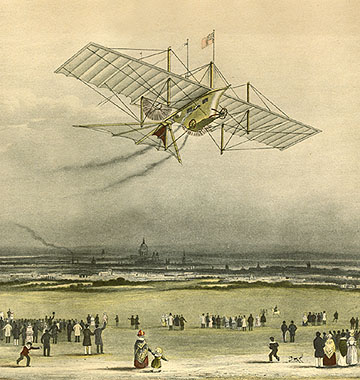
Nigel is perhaps the character who best embodies Victorian society's progressive, optimistic attitudes: as far as Nigel's concerned, science can get things done as long as you stick to it and keep exploring. Steampunk as a genre takes these attitudes and propels them in a science fiction direction, allowing the Victorian world to evolve into a mirror image of our modern society were it powered primarily by steam and not electricity. However, when you look at the things the Victorians were actually doing during the 19th century, steampunk really isn't too far off as a possibility. I mean, look at this thing:

This is Henson's Aerial Steam Carriage, also known as Ariel, in a painting from 1843.
Henson's Aerial Steam Carriage was patented in 1842. By 1848, a small mockup of the thing made successful flights in a hangar. Powered by steam, the machine was designed to ferry passengers like jet planes do today. Unfortunately, it was too heavy to properly lift off, much less carry people, but it was a step in the right direction. Oh, and this thing is real. Ariel existed. It looks a lot like something out of a Verne book, doesn't it?

There's plenty more examples out there, definitely. I won't put them all in one giant post, but they're out there. Basically, the point is that steampunk is closer to what actually happened than most people think it is - there's a ton of genuine history that is essentially 'real steampunk.' And that's the kind of steampunk you'll see from me.