So the Georgians had laughing gas parties...

Thursday, July 12, 2012

I watch game shows quite often, generally because the completely random things they ask the contestants from time to time give me ideas for things to look into. Today I happened to hear a question regarding the early use of nitrous oxide, so I looked into it...and found this.

Namely, in the 1790s, aristocrats started using nitrous oxide recreationally at parties. They referred to these as 'laughing gas parties' and basically all gathered in rooms and breathed in the gas until they reached a euphoric state. It sounds an awful lot like getting high with your friends, only with less harmful drugs and more gases that work as anesthetics. I can't speak from experience on either front since the only drugs I've ever taken at the dentist are modern anesthesia and Novocain and the only recreational drug I've ever used doesn't really count since it's the caffeine in my soda (although I am trying to curb my addiction, which is a story for another time), but I think it's a fitting analogy.

I did a little research on these 'laughing gas parties' because it sounded like something Nigel would stumble onto in his research and have to experiment with because he's Nigel, and here's what I found:

By the 1860s, nitrous oxide was being used as anesthesia for dentistry, but until then it was relatively uncommon and hard to come by, so these parties were generally reserved for the wealthier set. That being said, Nigel has access to both scientific research and money, so he'd be able to grab some for himself easily to see if it both kills pain and makes people euphoric and giddy. Which means he needs test subjects. Which means the domestic staff should run very, very far away because he tends to experiment on them.

And then there's his deadpanning big brother - Basil's involvement in this could be pretty darn interesting. I'll be filing this one away to see what I can do with it at a later time...

Using The Right Terms For Victorian Photography

Monday, April 23, 2012

This is easily the most random post I've ever written, but after messing around with the 'time machine' filters on Paint Shop Pro too much tonight I realized how much I hate when people just apply the terms 'daguerreotype' or 'tintype' to EVERY SINGLE PHOTO they see from the 19th century. There were a bunch of different photography techniques in use throughout the century, and many, if not most, of them overlapped. Let's talk about those now just so I can get this off my chest and fall asleep soundly.

To demonstrate the use of some of the more common ones, I took a drawing of Dustin, did some strange things with it in Paint Shop Pro, and then applied the time machine filters that were applicable to it.

Trashed Londinium Ideas: The Post

Monday, April 16, 2012

I don't quite know what inspired this post, but there have been quite a few trashed Londinium ideas over the years, and I can share them now since they won't appear in the books at all. I started this book as a sophomore in high school, when I was young and stupid. I'm older and slightly less stupid now, so my ideas are significantly better than they were seven years ago.

Seriously, Londinium is going to turn eight years old in December. That's kind of scary to think about.

Anyhow, I'm going to go through trashed ideas year by year, starting in December of 2004 when this project was first conceived. There are a lot of terrible ideas in my little green ledger. It's very pitiful.

2004

  • Charlie was raised in an orphanage/workhouse, not the brothel his mother worked at. This was deemed too similar to Oliver Twist and was therefore dropped.
  • Basil is originally listed in my notes as being the "intern to a banker." Yeah. About that...
  • Dustin only cleaned chimneys - no mention of his musical talents. He also often longingly looked at a rich "lady in the window," with whose world he was fascinated and knew he'd never reach.
  • Annabell Simmons and Basil originally stopped dating due to another man. This changed within one day.
  • 'Guvmate,' the one thing retained from the earlier notes, dates back to 12/15/04, but it's been rewritten what feels like upwards of ten times. 
  • Monty Houghton first appears in my notes on 12/20/04 as a much more violent, angry person than he is now.
  • Dustin's original height was 5'8". He's now 5'2".
  • Sullivan, the man Dustin was apprenticed to when he was learning how to clean chimneys, was a jerkface, for lack of a better word. The only surviving image of him that is even slightly presentable is from my old deviantART account:

2005
  • There are legitimate notes regarding something called "Londinium the Musical." There are even some song attempts in existence. I should probably light those on fire.
  • Robert Sheldon was actually diligent at work. Now he's a clock-watcher.
  • First mention of a poet on 1/10/05. Back then, the idea was supposed to be meaningful. This evolved into Kynaston Jordan, whose poetry was so bad that Basil and his friends used to do competitive readings of it at Eton. I like this better than the idea being meaningful.
  • Ironically, Sir Norwood Linsay and Gib Merton both appear in January 2005 and are essentially the same people, although their backstories are deeper now.
  • Monty was a sadist. He also spoke French, German and Russian and enjoyed saying "Au contraire, klavier!" which roughly translates to "On the contrary, piano!" 
  • Crispin Arlie existed. He was a crossing-sweeper that Gib semi-adopted. Once Gib's two little sisters entered the picture, Arlie was dropped.
  • Rescuing orphans - Dustin would save children impressed into being climbing boys and girls. He, Gib and Charlie also plucked an abandoned little girl named after an Enya song (Isobella) from the street and delivered her to an orphanage where Dustin brought all of his rescued children. At one point in the first draft, out of spite and anger Sullivan burned this orphanage down and the children and caretakers all ended up in Basil's parlor.
  • Kynaston Jordan was originally a traveling actor who wrote bad poetry.
  • Dustin ended up becoming a stage actor and went into performing Gilbert and Sullivan operas as he got older. Yeah, nope. He's better with the piano than his own voice now.
  • As late as 4/14/05, Basil was described as being "not very imaginative" and "a bit boring." Not exactly how you want to describe your lead character, that.
  • Rebecca Hillman. Basil was going to try courting her in the second book, but she never developed as a character.
Amazingly, there were no bad ideas in 2006, partially because other projects were taking up most of my time and my few notes from 2006 are research-based. The Cheese Beggar emerges as a character, as does Emily, Basil's former fiancee.

2007
  • Basil and Dustin are finally themselves, at least. It's the little things like proper characterization that make going through all my bad ideas so worth it.
  • Except that Dustin was still 5'7.5". He had some shrinking to do.
  • Basil's family was originally low on money because a cousin of his had gambled it all away, which forced him into working in the bank. This was only recently changed because I had a more realistic and generally better idea.
  • Jasper Leggett, Philander Midgeley, Gifford Hoadley and Royden Stagg. Look at their names. Take their initials (JL, PM, GH, RS) and it makes it easier. They were an opera quartet of young men who toured Europe and America performing arias and the like, with young women swooning at their feet as if they were Franz Liszt. ...yeah, they were meant to be a Beatles parody. How did you ever figure that one out, I wonder?
   
Look at how darn clever I thought I was.
 Fortunately, since 2007 I've been in a massive rewriting process, and these bad ideas have generally been either changed into good ideas or removed from the plot entirely. This just goes to show you that writing is a process - your first draft won't necessarily be your final one, and your characters will grow and change as you write them and get to know them better. That being said, don't let this deter you from writing altogether, because sticking with it is how you actually get to that great story you're trying to tell. You'll have to sift through a lot of bad ideas before you hit upon the good ones, but in the end it's worth it.

To me, Londinium is definitely worth it, even with all of this horrible crap here. I'm glad I've stuck with these characters over the years and worked with them to tell their stories. I can guarantee you that if you stick with your cast and work together with them, you'll tell great stories, too.

Reconciling Steampunk With History

Friday, March 16, 2012

Nigel, Basil's little brother, dabbles in every science possible.
I personally greatly enjoy steampunk. It fascinates me to see speculative history - namely, what the Victorians would have done with our technology, albeit with their versions running on steam and other available power sources from the 19th century. In fact, I think it would be awfully fun to write a steampunk story at some point down the road. However, here's my problem - Londinium is strictly historical fiction, and I do a ton of research to make sure I get all of my details right. There's no place for science fiction in Londinium...

...or is there?

Turns out what I can do is include science fact. The easiest way for me to do that is, of course, more research. See the fellow in the post here? That's Nigel Remington, Basil's younger brother. Nigel explores everything. He dabbles in biology, chemistry, physics, astronomy, ancient civilization, and even Babbage's difference engines (computers - really). Above all, Nigel's dream is to achieve powered flight, and whilst he won't be pulling that one off (some folks from Dayton, Ohio beat him to that in 1903), he tries every possible solution available to him in 1863. He's taught himself how to read hieroglyphics from other scholars' research, making him one of the few individuals in Britain at the time who can read them, and he eventually earns himself a position at the British Museum due to this skill. (He's the younger son and doesn't inherit the estate - Basil does - so he needed a job.)

Nigel wasn't going to be a very important character initially, but when I realized what I could explore with him he became much more prominent in redrafts. It's Nigel's brain that gets the cast through difficult situations a lot of the time, namely because he's so off-the-wall brilliant and thinks outside the box. If Londinium does well enough, I might even consider giving Nigel a Jules Verne-style spinoff series of his own just because it would be fun to write.

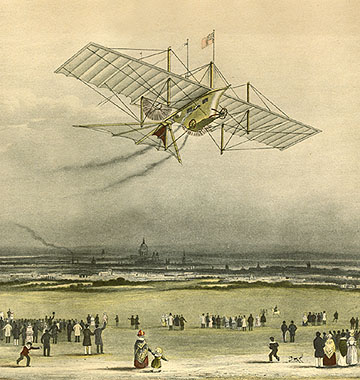
Nigel is perhaps the character who best embodies Victorian society's progressive, optimistic attitudes: as far as Nigel's concerned, science can get things done as long as you stick to it and keep exploring. Steampunk as a genre takes these attitudes and propels them in a science fiction direction, allowing the Victorian world to evolve into a mirror image of our modern society were it powered primarily by steam and not electricity. However, when you look at the things the Victorians were actually doing during the 19th century, steampunk really isn't too far off as a possibility. I mean, look at this thing:

This is Henson's Aerial Steam Carriage, also known as Ariel, in a painting from 1843.
Henson's Aerial Steam Carriage was patented in 1842. By 1848, a small mockup of the thing made successful flights in a hangar. Powered by steam, the machine was designed to ferry passengers like jet planes do today. Unfortunately, it was too heavy to properly lift off, much less carry people, but it was a step in the right direction. Oh, and this thing is real. Ariel existed. It looks a lot like something out of a Verne book, doesn't it?

There's plenty more examples out there, definitely. I won't put them all in one giant post, but they're out there. Basically, the point is that steampunk is closer to what actually happened than most people think it is - there's a ton of genuine history that is essentially 'real steampunk.' And that's the kind of steampunk you'll see from me.

Let's Talk Victorian Cartoons

Friday, March 9, 2012

This is Will Conrad. Will is a 19th century cartoonist.
Cartooning as an art form is a relatively recent development. In the Western world, cartooning emerged from the lithographic print, an art form that was wildly popular in the 18th century. 18th century lithographic prints were often grotesque caricatures of people and events, serving as a social commentary of sorts, much like political cartoons do today. I have an entire book on them in my personal library called City of Laughter: Sex and Satire in Eighteenth-Century London. It's one of the most-bookmarked resources I have regarding the history of humor. The lithographs contained within are graphic, scatological, sexual, and basically inappropriate. Today, we'd probably label them NSFW. In the 18th century, you could find them hanging in shop windows for all to see, however - people would gather around them, point and laugh, and discuss them. By the 1820s, however, the censors began to rear their ugly heads, and these prints disappeared off the market forever, with what would evolve into Victorian family values winning out. (Of course, there were still prints - they were just cleaner. That doesn't mean "not racist," "not sexist" or just plain "not wrong," but there's no sex or scat anywhere.)

By the time Londinium takes place in 1863, cartooning has evolved into a way to poke fun at society without being too offensive. Even the cartoons appearing in Punch aren't exactly hard satire anymore - they're just little commentaries on how strange fashion is or how odd it is that people take arsenic to look pale when it's actually going to potentially kill them. The perennial example, of course, is this one:

Arabella Maria: "Only to think, Julia dear, that our mothers wore such ridiculous fashions as these!"
Both: "Ha ha ha ha!"
That couldn't be further from what was being drawn just fifty years prior. It's much gentler. Satirical writing, too, had become much gentler, which is something that Basil constantly lamented about as a teenager at Eton in the 1850s. Basil's best friend at Eton, Will Conrad, was his illustrator. In order to rebel against comedic writing going soft, Basil wrote some very hardcore satire based on a rumor involving a teacher at the school who was strangely affectionate towards his horse. Although the 'Dirty Schoolboy Papers' were never published, Basil got his start as a satirical writer by penning them. In turn, Will, whose dream as a boy was to be a cartoonist, set out on his quest to be published by Punch.

Will doing what he does best: drawing porn.
By the time 1863 has rolled around, Will is working in London as a stockbroker, but he's still freelancing as a cartoonist in his spare time. He's also found a very grown-up way to rebel against the social mores of his society: collecting and parodying pornography. Will's fondness for the hilarity of purple prose combined with his enjoyment of going against the grain have turned him into something that most people would deplore in public, even though Victorians' private lives were far more sexual than anyone realizes. That's a post for another time, though.

Today, we use cartoons to make a statement, just like we did in the 18th and 19th centuries. What's considered appropriate to publish has changed over the years, certainly, but cartooning's purpose hasn't changed very much: it's there for us to say things that we can't always articulate with words. Pictures are supposedly worth 1,000 of 'em, after all. The only thing that's really changed is the techniques people use to draw and the things that we deem okay to show to the world. Cartoonists today can still get in trouble, of course, because there are certain lines you can't cross (remember the Danish cartoonist who drew Muhammad and what happened there?), but generally, things are more open today than they were in Will's day. We're probably not going back to the 18th century, mind you, but at the very least, artistic expression isn't something that gets censored very much anymore.

Will himself would be very, very proud.

Sketch Cards!

Saturday, March 3, 2012

I get to pimp the boys out in a public place on Saturday, March 17th, on which date I'll be at the Blick Art Materials in Paramus, New Jersey (it's on Route 4) doing an artist sketch card swap. Everyone participating got two cards each, so of course I ended up drawing Dustin and Basil on mine.

(This is the first time I've ever done sketch cards, so forgive me if they're not very good.)


I'm going to do a post on Victorian cartooning at some point soon since I've been back into that lately, so stay tuned! That will likely star Basil's school chum, my fellow cartoonist Will Conrad.

Londinium Art has a web home!

Thursday, March 1, 2012

Today I read the first book in the Hunger Games trilogy. It took me 5.5 hours. Specifically, it took even less time than that because I took a roughly 45-minute break for dinner. I'll be reading the next two soon, as well, because Suzanne Collins has an incredible grasp on how to pace a book to keep the reader hooked. Basically, I need to make sure you're all hooked on Londinium the same way. I sincerely hope I do my job and that ends up being the case...!

Anyhow, silly art that I draw relating to this book and its planned follow-ups now has its own internet home on my Nabyn account, so go check it out by clicking the picture of Basil and Dustin, won't you?

twitter-128